Do AI-Generated Cover Letters Work? New Evidence From Millions of Applications
A recent study analyzed real outcomes when a job marketplace rolled out AI cover letter tools. The results are both encouraging and a little uncomfortable.
TailorDraft Team
January 20, 2025
If you've ever wondered whether an AI-generated cover letter helps (or hurts) your chances, there's finally research that looks at real outcomes at scale.
A recent study on arXiv analyzed what happened when a major job marketplace rolled out an AI cover-letter writing tool. The results are both encouraging and a little uncomfortable:
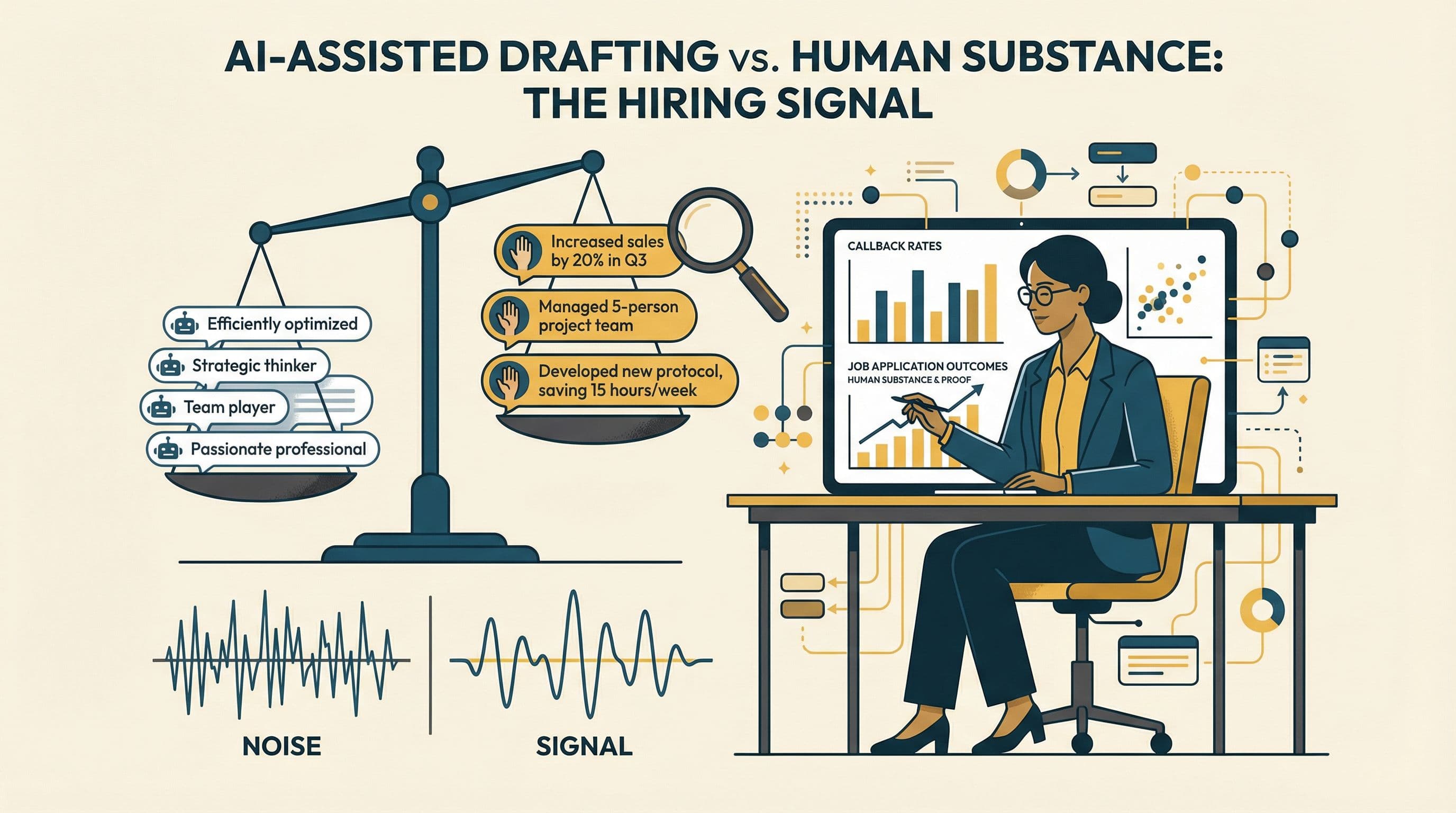
AI cover letters can increase callbacks. But they can also make cover letters less meaningful as a signal.
That means the "easy win" of polishing text isn't the whole game anymore. The advantage shifts to candidates who can still provide credible proof that they fit the role.
What this research studied (and why it matters)
The paper, "Signaling in the Age of AI: Evidence from Cover Letters", examines a platform rollout of an AI tool (an "AI Bid Writer") that helps applicants generate cover letters at the point of applying. Employers generally couldn't directly observe whether someone used the tool, which makes the setting unusually useful for measuring real effects.
Source: arXiv:2509.25054
Because the researchers observe tool access, tool usage, and downstream outcomes, they can estimate whether AI-writing support changes the odds of getting a callback (and more broadly, how the market responds).
The headline result: AI use is linked to more callbacks
The study finds that using the AI writing tool is associated with a higher probability of receiving a callback.
- Tool access (having it available) is associated with a modest increase in callback likelihood.
- Actual tool usage is associated with a much larger increase, on the order of a meaningful relative lift versus the baseline callback rate in their data.
What "efficiency" means in job-search terms
If you define efficiency as:
callbacks per hour spent applying
…then AI can genuinely improve efficiency by helping you create an acceptable draft faster and apply to more roles without starting from scratch each time.
But that's not the full story.
The catch: when everyone can "tailor," tailoring stops signaling quality
One of the most important findings is not just that callbacks rise for users, but that the marketplace changes.
After the AI tool is introduced, the relationship between "tailoring" (how closely the cover letter aligns with the job) and callbacks drops sharply. The paper estimates a decline around ~51%.
Translation: recruiters adapt
When tailoring becomes cheap and common, employers learn:
- "This letter sounds tailored" no longer reliably means "this candidate is a great fit."
- So they discount the letter and rely more on other signals (work history, ratings, portfolio, proof of past performance).
This is the "signal dilution" problem.
AI makes it easier to generate polished words, but it also makes polished words less persuasive on their own.
Another key insight: editing effort matters
The study also reports that more time spent editing the AI-generated draft is positively associated with better outcomes.
This aligns with what many hiring managers informally report: a generic AI letter can be spotted (or simply felt) even if it isn't explicitly detected.
AI can get you to Draft 1 fast. Your results depend on what you do next.
What this means for job seekers (especially in 2026)
1. AI can help, but it's not a cheat code
Yes, AI-generated cover letters can be linked to better outcomes in this study's setting. But if everyone can produce a clean, tailored-sounding letter, that part stops being differentiating.
Your edge isn't "nice writing." It's credible specificity.
2. The new "signal" is proof
As cover letters lose signaling power, employers pay more attention to what's harder to fake:
- concrete accomplishments
- metrics
- specific tools and workflows
- domain knowledge
- portfolio artifacts
- references, ratings, or track record
3. The cover letter still matters, but differently
A cover letter is less about being elegant and more about doing two things quickly:
- Prove you've done something similar before
- Map that proof to what the job actually needs
A 10-minute cover letter upgrade checklist
If you're using AI (and most people are, or will), aim for this workflow:
Step 1: Add one role-matching story (2 minutes)
Include a short mini-case:
- "In my last role, I handled X, which is similar to your Y, and the outcome was Z."
Good: specific scenario + outcome Weak: "I am passionate about your mission."
Step 2: Add two quantified proof points (3 minutes)
Pick any two:
- revenue impact
- cost reduction
- time saved
- scale (users, tickets, volume)
- quality metrics (accuracy, error reduction, SLA)
If you don't have numbers, use credible proxies:
- "reduced weekly reporting from 3 hours to 45 minutes"
- "supported 12 stakeholders across 4 departments"
Step 3: Add one "hard-to-fake" detail (2 minutes)
This is the tiny detail that signals reality:
- tool stack (use specific names)
- stakeholder environment
- constraints (regulated environment, tight deadlines, cross-functional teams)
- "how" you did it (method, cadence, process)
Step 4: Cut the generic fluff (2 minutes)
Delete or rewrite lines like:
- "I'm a hardworking self-starter…"
- "I'm excited about the opportunity…"
- "I have strong communication skills…"
Replace with proof or remove entirely.
Step 5: Tighten the opening (1 minute)
Your first paragraph should do one job:
state fit + reference the role + preview proof
Practical takeaway
Use AI to move faster. Use your edits to move upmarket.
AI improves the drafting part of the process. Your outcomes depend on the evidence you add: the proof that you're not just tailored in words, but tailored in substance.
This is exactly why tools like TailorDraft focus on mapping your real experience to role requirements, not generating generic polish. You provide ground truth, it maps the fit, and you review every line before it becomes your application. No invented credentials.
Try this next
If you're applying this week, run a simple experiment:
- Version A: AI draft with light cleanup
- Version B: AI draft + the 10-minute upgrade checklist above
Track callbacks over 10–20 applications. The pattern is usually obvious.
Want to produce "Version B" style cover letters consistently? TailorDraft maps your real experience to each role's requirements. Start free with 50 credits.
Put This Into Practice
TailorDraft helps you create tailored resumes and cover letters for every application — grounded in your real experience.
Start Free50 free credits included. No subscription required.